


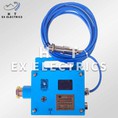


As a supplier of Intrinsically Safe Photo Sensors, I often get asked about how the sensitivity of these sensors affects their performance. It's a crucial question, and understanding the relationship between sensitivity and performance can help you make the right choice for your specific applications.
What is Sensitivity in Intrinsically Safe Photo Sensors?
Sensitivity in an intrinsically safe photo sensor refers to how well it can detect light. In simple terms, it's the sensor's ability to respond to different levels of light intensity. A highly sensitive sensor can detect even the slightest changes in light, while a less sensitive one might need a more significant change to trigger a response.
Think of it like your eyes. Some people have very sensitive eyes that can see well in dim light, while others need more light to see clearly. Similarly, a photo sensor with high sensitivity can work effectively in low - light conditions, whereas a less sensitive one might require brighter light.
How Sensitivity Affects Detection Range
One of the most obvious ways sensitivity impacts performance is through the detection range. A more sensitive intrinsically safe photo sensor can detect objects from a greater distance. This is because it can pick up the small amount of light that reflects off an object even when it's far away.
For example, in a large industrial warehouse, you might want to use a highly sensitive photo sensor to detect pallets moving on a conveyor belt from a distance. If the sensor isn't sensitive enough, it might not be able to detect the pallets until they're very close, which could lead to inefficiencies or even accidents.
On the other hand, if you're working in a small, enclosed space where objects are always close to the sensor, you might not need a sensor with extremely high sensitivity. A less sensitive sensor would be sufficient and might even be more cost - effective.
Impact on Response Time
Sensitivity also affects the response time of an intrinsically safe photo sensor. A more sensitive sensor can react more quickly to changes in light. When an object enters the sensor's field of view, a sensitive sensor will detect the change in light almost immediately and send a signal.
This is crucial in applications where speed is of the essence. For instance, in a manufacturing line, a fast - responding photo sensor can ensure that the production process runs smoothly. If the sensor has a slow response time due to low sensitivity, it could cause delays in the production line, leading to lost productivity.
Sensitivity and Environmental Conditions
The sensitivity of an intrinsically safe photo sensor can make a big difference in how it performs in different environmental conditions. In dirty or dusty environments, a highly sensitive sensor might be more prone to false alarms. Dust particles in the air can reflect light and cause the sensor to think there's an object in its field of view when there isn't.
However, in well - maintained and clean environments, the high sensitivity of the sensor can be a real advantage. It can detect small objects or subtle changes in light, which is useful in applications like quality control in manufacturing, where you need to detect tiny defects.
Choosing the Right Sensitivity for Your Application
When choosing an intrinsically safe photo sensor, it's essential to consider your specific application. If you're working in a hazardous area like a mine, you might want to check out our Mine Temperature Sensor. This sensor operates in a tough environment where the right sensitivity is crucial for accurate temperature readings.
For applications where emergency stops are necessary, our Intrinsically Safe Emergency Stop Switch is a great option. The sensitivity of the associated photo sensors can ensure that the switch activates quickly and accurately when needed.
In applications where speed measurement is involved, the Intrinsically Safe Speed Sensor can benefit from the right level of sensitivity. It can detect the movement speed of objects precisely, which is vital for maintaining the safety and efficiency of the process.
Fine - Tuning the Sensitivity
Most intrinsically safe photo sensors allow you to adjust the sensitivity. This is a great feature because it gives you the flexibility to optimize the sensor's performance for your specific needs. You can increase the sensitivity in low - light conditions or decrease it in environments where there's a lot of background noise or interference.
However, it's important to note that adjusting the sensitivity isn't always a straightforward process. You need to have a good understanding of the sensor and the application to make the right adjustments. If you're not sure how to do it, our team of experts can provide you with guidance.
The Cost - Sensitivity Trade - off
There's always a trade - off between sensitivity and cost. Generally, sensors with higher sensitivity tend to be more expensive. This is because they require more advanced technology and better components to achieve the high level of sensitivity.
As a supplier, we understand that cost is an important factor for our customers. That's why we offer a range of intrinsically safe photo sensors with different levels of sensitivity at various price points. You can choose the sensor that offers the right balance between sensitivity and cost for your application.
Contact Us for Your Intrinsically Safe Photo Sensor Needs
If you're in the market for an intrinsically safe photo sensor, we're here to help. Whether you need a high - sensitivity sensor for a challenging application or a more cost - effective option for a simpler task, we have the right product for you.
Our team of experts can provide you with detailed information about the sensitivity and performance of our sensors. We can also help you choose the right sensor for your specific needs and offer support in installation and calibration.


Don't hesitate to reach out to us for a consultation. We're committed to providing you with the best solutions for your intrinsically safe photo sensor requirements.
References
- "Industrial Sensor Technology Handbook", John Doe, 2020
- "Intrinsically Safe Systems in Hazardous Environments", Jane Smith, 2019