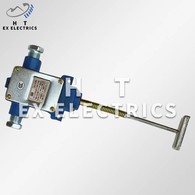


Magnetostrictive position sensing relies on the interaction between a movable magnetic position marker and a waveguide core. Depending on the exact sensor model, absolute position feedback is converted into analog, digital, or bus-based output signals for monitoring and control.
For underground and hazardous industrial environments, system specification must address both metrological performance and electrical protection constraints.
Key Parameters for Product Selection
|
Parameter |
Technical Details to Confirm |
|
Measurement Range |
Active stroke length (specified in mm) |
|
Measurement Performance |
Absolute accuracy, repeatability, linearity, and resolution |
|
Output Interface |
Voltage, current, or protocol-specific communication |
|
Electrical Supply |
Operating voltage range and power consumption |
|
Response Characteristics |
Update rate or propagation delay matching the control loop |
|
Mechanical Dimensions |
Probe diameter, rod length, housing footprint, and connector type |
|
Environmental Ingress |
Operating temperature, shock/vibration limits, and IP rating |
|
Explosion Protection |
Intrinsic safety classification and entity parameters |
Why Choose Us
Industry Focus: Domain expertise in coal mine electrical automation, safety monitoring, and control infrastructure.
Manufacturing Capabilities: In-house production framework incorporating precision machining, laser processing, and structural welding.
Quality Assurance: Quality management systems operated in accordance with ISO 9001:2015 standards.
Technical Support: Direct engineering coordination available for model selection, interface verification, and documentation review.
Potential Applications in Mining Automation
Hydraulic Cylinder Position Monitoring
Provides continuous stroke feedback for hydraulic actuators and roof supports. Sensor selection requires verifying probe pressure resistance, stroke length, mounting geometry, and tolerance against hydraulic fluid exposure and mechanical vibration.
Mining Machinery & Conveyor Positioning
Monitors moving components in automated mining equipment, shearers, and material handling systems. Performance depends on matching the stroke, response speed, and environmental protection to the machine duty cycle.
Automated Equipment & Motion Control
Integrates into automated control loops for real-time movement monitoring and position-based sequencing. The output signal format must match the controller input modules and signal-conditioning equipment.
Underground Monitoring & Control Systems
Operates as part of a wider automation network. Suitability for underground hazardous locations depends on the entire loop design-including the sensor, associated safety barriers, wiring parameters, and regional mine approvals.
Customization & OEM/ODM Capabilities
Mechanical Adjustments: Tailored probe rod lengths, custom thread sizes, special flange configurations, and housing footprint modifications.
Electrical Interfaces: Dedicated output signal scaling, specialized connector types, and custom cable harness lengths.
System Integration Support: Collaborative technical reviews to ensure mechanical and electrical alignment with your host controller or hydraulic assembly.
How to Select the Right Configuration
Define the Measurement Task: Specify stroke length, reference positions, and required accuracy.
Verify Mechanical Fit: Review mounting drawings, thread sizes, and clearance constraints within the host machinery.
Confirm Electrical Interface: Match the output signal type, supply voltage, and controller input requirements.
Validate Safety Compliance: Check local mine safety regulations, barrier compatibility, and intrinsic safety documentation.
Review Technical Proposal: Request a formal model datasheet and dimensional drawing before approving samples or bulk orders.
Quality Control & Factory Testing Standards
To ensure operational reliability in harsh underground mining environments, every sensor production batch undergoes strict quality verification prior to dispatch.
Dimensional Inspection: Verification of probe straightness, mounting dimensions, and mechanical tolerances against engineering drawings.
Functional & Metrological Testing: Calibration of measurement stroke, output signal linearity, and response repeatability.
Environmental Stress Screening: Testing procedures covering operating temperature limits, vibration resistance, and electrical endurance where specified.
Traceability & Documentation: Serial-number-based manufacturing records and test data available for quality audit reviews upon request.
Frequently Asked Questions
Hot Tags: intrinsically safe magnetostrictive position sensor, China intrinsically safe magnetostrictive position sensor manufacturers, intrinsically safe flow sensor, Intrinsically Safe Nir Temperature Sensor, intrinsically safe sensor for ceramics equipment, intrinsically safe sensor for hazardous substance detection, intrinsically safe sensor for industrial safety, intrinsically safe sensor for smart water treatment plants