


System Overview
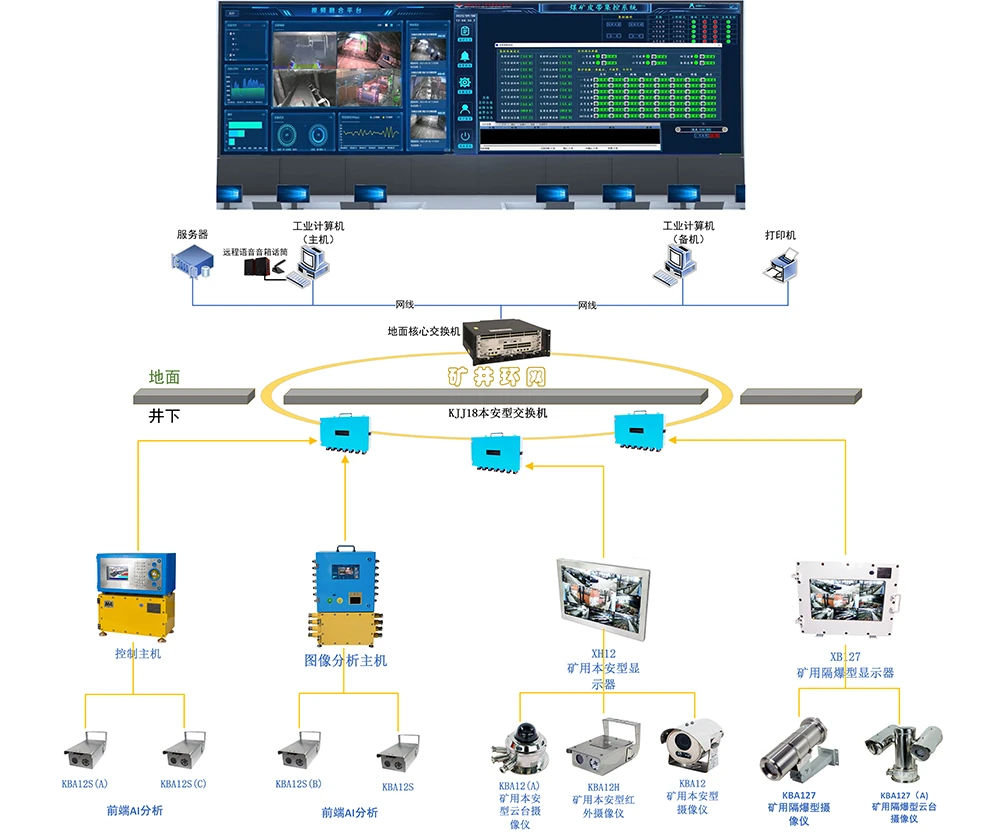
The Coal Mine AI Analysis System is an intelligent monitoring and identification system. It is based on the coal mine surveillance system and utilizes AI image recognition algorithms as its core. The system conducts real-time monitoring and identification of personnel, equipment, environment, processes, vehicles, and maintenance within the coal mines. It includes functionalities such as vehicle and pedestrian detection, violation of rules identification, area intrusion detection, large coal and foreign object recognition, conveyor belt idling and misalignment detection, and smoke and fire recognition, meeting the application needs of various scenarios in the coal mining industry.
Front-end Design
The intelligent video AI analysis system adopts a front-end processing approach, embedding the algorithms directly into cameras. It can interact with other devices through switch quantity and Modbus TCP/RTU. The alarm results and video streams can be directly uploaded to the data platform via a ring network. The advantage of front-end algorithm processing: Since the AI algorithm is embedded in the camera, the video data is analyzed where it is collected, with the process completed within the camera itself. The analysis results are uploaded to the central server. This is distinctly different from back-end processing, as the original video does not need to be uploaded to the server first. The system can continue to operate normally even during network disruptions, and once the network is restored, it can resume uploading alarm information to the server, effectively solving issues related to network delays and disconnections.
System Composition
Industrial Computer and Supervisory Control Software: Features video squares, video retrieval, electronic maps, video playback, device management, user management, alarm inquiry, AI intelligent analysis, configuration center, and plugins, supporting web browsing.
KBA12S(B) Mining Intrinsically Safe Image Processing Camera: Analyzes captured images to detect open flames and can interact with other devices via switch quantity and Modbus TCP/RTU.
KBA12S Mining Intrinsically Safe Image Processing Camera: Analyzes captured images to detect intrusion activities and can interact with onsite warning devices via switch quantity and Modbus TCP/RTU.
KBA12S(C) Mining Intrinsically Safe Image Processing Camera: Analyzes captured images to check if workers in the detection area are wearing safety helmets and can interact with onsite warning devices via switch quantity and Modbus TCP/RTU.
KBA12S(A) Mining Intrinsically Safe Image Processing Camera: Analyzes captured images to assess the working status of conveyor belts, belt misalignment, and coal flow, and can interact to adjust belt speed via Modbus TCP/RTU.
ZSJ127-Z Mining Explosion-Proof and Intrinsically Safe Image Monitoring Alarm Control Device Host: Configures camera algorithms, video surveillance, and controls the linkage and output of cameras.
KDW127/12 Mining Sealed and Intrinsically Safe Direct Current Stabilized Power Supply: Supplies power to mining intrinsically safe image processing cameras.
KJJ18 Mining Intrinsically Safe Switch: Provides network ring and data exchange functions in underground coal mines.
KTC169.1 Mining Explosion-Proof and Intrinsically Safe Communication Controller: Monitors the status of conveyor belts, displays data, and serves as a standalone control center, linking image processing cameras.
System Functions
1.Video Fusion Platform
The video management service supports encoding devices connecting to the platform via various protocols such as Hikvision Device Network SDK, Hikvision Ehome, Hikvision ISUP5.0, GB28181, ONVIF, Dahua Device Network SDK, and Ezviz. This setup enables capabilities like real-time video preview, video playback, video walling, and video event monitoring. In networks with limited bandwidth or traffic restrictions, the system can offer monitoring services by substituting videos with images.
The platform is highly compatible, able to cover nearly all video surveillance devices on the market, which is advantageous in scenarios that utilize existing equipment. During project implementation, the system is integrated into the entire network using existing resources without needing extensive equipment replacement. This not only simplifies the system implementation process and reduces complexity, but also significantly lowers system investment costs and reduces the effort needed for management and maintenance.
The main interface of the video fusion platform includes features such as a device tree, system resource usage, multi-screen display, and alarm events. Backend management features include a video square, video retrieval, electronic map, video playback, device management, user management, alarm query, AI intelligent analysis, configuration center, and plugins, all designed for simple deployment and ease of operation.
2.Front-End Video Analysis
The front-end video analysis is conducted using mining intrinsically safe image processing cameras equipped with front-end AI analysis capabilities. Algorithms embedded directly in the cameras allow for immediate analysis of the footage, effectively eliminating any latency, which is particularly critical for situations requiring swift responses. The cameras output standard signals such as switch quantity, RS485, and TCP protocol, facilitating direct integration with other devices. This setup effectively resolves issues related to network delays and disconnections. Moreover, alarm results and video streams can be directly uploaded to the data platform via a ring network, ensuring reliable and prompt communication of critical information.
3.High-Definition Video Surveillance
Explosion-proof and intrinsically safe cameras enable real-time monitoring of both surface and underground work sites, with centralized displays in locations such as control rooms or hoist rooms. This facilitates production scheduling, online hazard detection, and emergency response operations.
4.Hard Disk Recording
Uses various methods to record surveillance footage, featuring manual recording, scheduled recording, voice alarm, alarm recording, and motion detection recording. It includes access control management and operation log functionalities.
5.Storage Function
After a system power outage or shutdown, all system data, user settings, and operation logs are maintained without loss for at least 7 days. Upon re-powering, the system should restore to the state it was in before the power loss or shutdown.
Main System Equipment
Control Devices


(4)KBA12S(C) Mining Intrinsically Safe Image Processing Camera: Employs front-end AI video analysis to determine if there is an open fire from the captured images. It can interact with other devices via switch quantity and Modbus TCP/RTU, facilitating coordinated responses. The camera is equipped with voice intercom, real-time monitoring, and recording capabilities.


(6)KBA12S(A) Mining Intrinsically Safe Image Processing Camera: Utilizes front-end AI video analysis to evaluate captured images for assessing the operational status of conveyor belts, belt misalignment, and coal flow. It can interface with other devices to adjust belt speed via Modbus TCP/RTU. Additionally, the camera features voice intercom, real-time monitoring, and recording capabilities.


