System Overview
Project Background
According to notifications from the Shanxi Bureau of the National Mine Safety Supervision Administration, the Shanxi Provincial Emergency Management Department, and the Shanxi Provincial Energy Bureau, regarding the promotion of "electronic fences" in hazardous work areas in coal mines across the province. To implement management of hazardous underground work areas and effectively prevent accidents such as injuries from the cutting heads of roadheaders, injuries from the claws of loaders, injuries from the cutting heads of coal cutters, and injuries from crushers, thereby improving the safety level of mines and promoting the installation of "electronic fences" in hazardous work areas underground in coal mines. As the scale of mines and the construction process of intelligent mines accelerate, the application of large-scale equipment underground in coal mines is also increasing, adding to the burden on already cramped spaces, and the underground work environment in coal mines is complex, especially in the roadway excavation and coal mining faces. The workspaces are limited, lighting is insufficient, and the construction personnel and equipment are relatively dense. Due to some underground production workers having weak safety awareness, being careless, illegally entering dangerous areas, and illegally operating large-scale electromechanical equipment, accidental injuries occur. To address the above issues, there is an urgent need for "electronic fence" technology to timely emit audio and visual alarm signals and trigger equipment shutdown when workers enter hazardous areas, to avoid accidents.
Implementation Goals
The "electronic fence," also known as a personnel proximity protection system, is a safety protection system primarily used for safety warnings in key hazardous areas underground such as excavation workfaces, coal bins, enclosed walls, and belt conveyors. This system utilizes infrared thermal imaging technology and radar technology to detect when workers enter hazardous areas, promptly emitting audio and visual alarms and triggering equipment shutdown to prevent accidents. For example, by installing the "electronic fence" system on a roadheader, multiple layers of protection are formed around the working area of the roadheader, effectively preventing personnel from mistakenly entering dangerous areas. During the operation of the roadheader, it can timely and effectively detect human activity, trigger audio and visual alarms, and stop the machine, fundamentally eliminating the hidden dangers of accidents caused by machinery injuring people, thereby effectively protecting personal safety.
Applicable Situations
According to the actual needs of coal mines, it is planned to install "electronic fences" in hazardous areas including the excavation equipment at the mine's excavation workface, anchor support equipment, auxiliary operation equipment, feed crushers, the head car parts of continuous miners, the drive section of the mine's main belt conveyor, the tail drum section, coal chutes, the upper/lower mouth of the coal bin, the exterior of the sealed wall, and the transfer machines at the coal mining face. This installation aims to address the safety hazards present at the underground production sites.
Design Scheme
Infrared Thermopile Technology "Electronic Fence"
The infrared thermopile technology "electronic fence" mainly consists of mining-specific infrared thermopile sensors and mining-specific explosion-proof and intrinsically safe audio-visual signal devices. Infrared thermopile sensors are installed in hazardous areas and use audio-visual alarms to alert personnel approaching the area. This setup ensures that if personnel intrude into hazardous underground areas during the operation of units/equipment, it immediately triggers a pre-warning and stops the machinery to prevent dangerous accidents.

When personnel intrude into the "electronic fence" and cross the preset safety distance, the system triggers the "electronic fence" to send a linked signal that stops the operation of associated equipment and cuts off its power, locking it down. At the same time, it activates an alarm voice message and causes the signal device's red light to flash as a warning. When the protective conditions are removed, the system sends a reset signal to the associated equipment, automatically unlocking it and allowing manual restart of the equipment. This prevents personnel in hazardous areas from being injured due to the operation of the equipment, thereby enhancing the safety management level of the mine.
New Radar Technology "Electronic Fence"
The new radar technology "electronic fence" primarily consists of mining-specific intrinsically safe proximity alarm devices and mining-specific mobile target identification alarm devices. Intrinsically safe proximity alarm devices for mining use are installed in hazardous areas to perform scene modeling and construction. These devices have the capability to monitor first, second, and third level areas. When a person or object not part of the background is detected in the monitored area, the system issues a pre-warning and outputs a control signal. This ensures that if personnel intrude into hazardous underground areas during the operation of units or equipment, it immediately triggers a pre-warning and stops the machinery to prevent dangerous accidents.

The alarm system can continuously monitor the first, second, and third level zones using radar technology. When a person intrudes into these monitored zones, the location of the person determines the activation level-first, second, or third level-each triggering its respective relay engagement and alarm. Specifically, when a person enters the third level, the alarm broadcasts a warning message; entering the second level triggers an alarm sound; and upon intrusion into the first level stop zone, the alarm sounds, and a linked signal is emitted to stop the operation of associated equipment and cut off its power. When the protective conditions are lifted, a reset signal is sent to the associated equipment, automatically unlocking it and allowing for manual startup. This setup prevents injuries from equipment operation within hazardous areas and enhances the safety management level of the mine.
The alarm system's left side, right side, the intervals between levels 1/2 and 2/3, and the distances for levels 1, 2, and 3, as well as 14 other parameters such as volume, alarm type, radar direction, communication address, and baud rate, can all be adjusted based on actual site conditions. Additionally, the alarm is equipped with RS485 communication, enabling it to transmit various information via the MODBUS protocol for communication with other devices, facilitating data upload and analysis.
Infrared Thermal Imaging Electronic Fence

The infrared thermal imaging camera can provide a high-definition video image, allowing real-time viewing of the current working status, along with a thermal imaging camera image. The thermal image captures the distribution of infrared radiation energy from the target using an infrared detector and an optical imaging lens, reflecting it onto the photosensitive elements of the infrared detector to obtain a thermal image. The system utilizes front-end AI algorithms and dual-spectrum fusion technology, and does not require a server, as it can independently complete the intrusion detection algorithm. It also features two-level pre-warning and one-level machine shutdown functions, and it is equipped with corresponding switch quantity output and Ethernet protocol. The pre-warning and shutdown areas can be directly set using a multi-point line drawing method, delineating these areas respectively. The display is intuitive and can be directly uploaded to the control center for monitoring via a ring network, displaying the captured images of the intrusion.
System Composition
1. Industrial computer and supervisory control software: Features video square, video retrieval, electronic map, video playback, equipment management, user management, alarm query, AI intelligent analysis, configuration center, plugins, etc., supports web browsing.
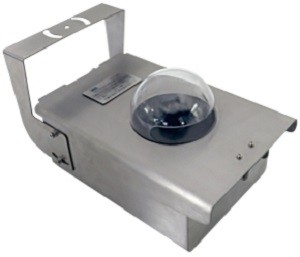
2. KBA12S mining intrinsically safe image processing camera: Analyzes collected images with AI to determine if there is any personnel intrusion, and can provide local warning reminders through switch quantity, Modbus TCP/RTU linkage.
3. Mining intrinsically safe infrared thermal imaging camera: Provides a high-definition video image and a thermal imaging camera image, capable of area intrusion detection and voice intercom monitoring equipment.
4. XH12 mining intrinsically safe monitor: A key device for real-time image surveillance of major production links, important equipment, and critical positions.
5. KXH127 mining explosion-proof and intrinsically safe audio-visual signal device: Mainly used for signal communication, alarm, and audio-visual indications.
6. ZP-12R mining automatic water spraying dust reduction device with thermopile light control sensor: Detects the presence of personnel in hazardous areas.
7. KJ1352-S mining mobile target identification alarm: Utilizes new radar technology to monitor and identify moving people or objects.
8. KXB12 mining intrinsically safe proximity alarm: Uses new radar sensing technology, features first, second, and third level monitoring areas, triggers relays and alarms when moving people or objects are detected in the monitored area.
9. KBA12J mining intrinsically safe laser radar camera: Uses new radar sensing technology, features first, second, and third level monitoring areas, triggers relays and alarms when moving people or objects are detected. Also features video surveillance, radar-video linkage, captures pictures or videos.
10. KDW127/12 mining sealed and intrinsically safe direct current stabilizing power supply: Provides power to mining intrinsically safe equipment.
System Functions
(1) When on-site personnel approach the coal mining face scraper conveyor head, transfer machine bridge, and crusher feed inlet in the pre-warning areas, the system automatically triggers audio and visual alarms to alert them; when personnel enter the hazardous areas, the system automatically stops the machine and issues alarm prompts.
(2) When on-site personnel enter the pre-warning area around the excavation face excavation equipment, the system automatically triggers audio and visual alarms; when they enter the hazardous area, the system issues audio and visual alarms and triggers the shutdown of the excavation equipment.
(3) When on-site personnel enter the pre-warning area around the excavation face anchoring equipment, the system automatically triggers audio and visual alarms; when they enter the hazardous area, the system issues audio and visual alarms and triggers the shutdown of the anchoring equipment.
(4) When on-site personnel enter the pre-warning area around the excavation face auxiliary operation equipment, the system automatically triggers audio and visual alarms; when they enter the hazardous area, the system issues audio and visual alarms and triggers the shutdown of the auxiliary operation equipment.
(5) When on-site personnel enter the hazardous range of the feed crusher and continuous miner head car, the system automatically triggers the equipment to stop and issues audio and visual alarms.
(6) When on-site personnel inadvertently enter a running belt conveyor, in special hazardous areas such as the belt overlap section and bridge erection section, the system sets a personnel detection pre-warning area; when personnel enter this pre-warning range, the system instantly triggers the belt conveyor to stop and issues alarm prompts.
(7) When on-site personnel enter the pre-warning areas of the coal chute or coal bin mouth, the system automatically triggers audio and visual alarms; when they enter the hazardous range, the system instantly triggers the transport equipment of the coal chute or the upper mouth of the coal bin to stop and issues alarm prompts.
(8) When on-site personnel enter the hazardous range near the sealed wall, the system automatically triggers audio and visual alarms for entering the hazardous area.
System Equipment


(4) XH12 Mining Intrinsically Safe Monitor: This monitor features a 24-inch color LCD display and is equipped with one Ethernet electrical signal interface and two Ethernet optical signal interfaces. It displays both black-and-white and color video images. The device supports the display and recording of up to 8 network video streams, with capabilities for single-channel playback or multi-channel simultaneous playback. It can be networked with other computer systems or alarm systems to facilitate remote transmission and viewing of recorded video data.


(6) ZP-12R Mining Thermopile Light Control Sensor: This sensor is designed with innovative features, reliable performance, and user convenience in mind. It is suitable for environments such as mine transport main roads, belt conveyors, coal storage yards, and excavation workfaces. When the sensor's probe detects a person passing within a 105-meter range, its built-in relay switches from normally open to closed, sending a signal to the control mainframe or an alarm system.