


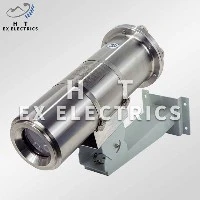


If you're tasked with monitoring hazardous industrial environments-think oil and gas refineries, underground coal mines, or chemical processing plants-you know that every second counts. When an alarm triggers, or a potential safety hazard emerges, the ability for your camera system to respond quickly can mean the difference between a minor adjustment and a catastrophic event. That's where the response time of an explosion-proof PTZ camera's pan-tilt movement becomes critical. As a supplier of these specialized cameras, I've spent years fielding questions about this exact metric, and today I'm breaking down what it really means, how it's measured, and why it matters more than you might think for high-risk operations.


First, let's clarify what we mean by "response time" for a PTZ camera. For non-explosion-proof units, this is often a straightforward number-the time from when a control signal is sent to when the camera starts moving from its current position to a new target. But explosion-proof PTZ cameras are not standard consumer or commercial security tools. They're built to withstand extreme conditions: flammable gases, dust, vibration, and temperature fluctuations that would disable regular cameras instantly. That rugged design directly impacts their movement response time, so you can't use off-the-shelf PTZ benchmarks here.
Let's start with the core components that drive pan-tilt response time in explosion-proof models. Unlike standard PTZs, which use lightweight plastic gears and small motors, explosion-proof units have to meet strict certification standards-like ATEX, IECEx, or NEC Class 1 Div 1. That means their internal parts (gears, motors, and enclosures) are made of heavy-duty materials: stainless steel, aluminum alloy, or cast iron, engineered to contain any internal spark that could ignite surrounding hazardous materials. The motors, too, are specialized: they're low-voltage, explosion-proof brushless DC (BLDC) or stepper motors, which are slower to start and accelerate than the high-torque motors in regular PTZs.
As someone who works with these cameras daily, I can tell you that most explosion-proof PTZ cameras on the market have a pan speed range of 0.1 to 120 degrees per second, and tilt speed of 0.1 to 90 degrees per second. But raw speed is only part of the response time equation. The full cycle includes three key phases: signal processing time, acceleration time, and movement stabilization time. Let's break each down.
Signal processing time is the delay between when you send a command (via a control interface, NVR, or built-in motion detection trigger) and when the camera's motor system receives that command. For standard PTZs, this is often less than 100 milliseconds, but explosion-proof units have to include intrinsic safety barriers to ensure that electrical signals don't produce arcs or sparks. These barriers add a small, consistent delay-usually between 150 and 250 milliseconds-because they regulate voltage and current to levels safe for hazardous areas. It's a necessary trade-off for compliance, and reputable suppliers like us design our systems to minimize this delay without sacrificing safety.
Next comes acceleration time. This is how long it takes the camera's motor to go from a complete stop to its maximum rated speed. For a standard PTZ, this might be 50 milliseconds, but again, the heavy-duty motors and gears in explosion-proof units change things. To avoid jarring the camera's enclosure or putting stress on the parts that need to keep sparks contained, explosion-proof PTZs use smooth, gradual acceleration. Most models take between 300 and 600 milliseconds to reach their top pan/tilt speed. That's a big difference from consumer units, but it's non-negotiable for reliability in harsh conditions.
The final, often overlooked, component is stabilization time. Once the camera reaches its target position, it needs to stop smoothly and hold steady-no wobble, no drift, because even a small vibration could interfere with image clarity, or in extreme cases, damage the sensitive enclosure seals. For standard PTZs, stabilization time is negligible, but explosion-proof cameras use precision encoders and dampening systems to ensure the camera locks onto its exact target. This adds another 200 to 400 milliseconds to the total response time, bringing the full end-to-end response time (from command to stable image at the new position) to between 650 milliseconds and 1.2 seconds.
Wait, I know what some of you are thinking: "1.2 seconds? That seems slow compared to a home PTZ that can move across the room in half that time." But here's the reality: in industrial settings, you're not moving the camera across a living room-you're scanning a 10,000-square-foot refinery, a half-mile stretch of pipeline, or a tunnel in a coal mine. The "target" isn't a small, close-up object; it's a valve, a sensor, or a potential leak that could be hundreds of feet away. The trade-off for that slightly slower response time is the ruggedness that lets the camera operate 24/7 in areas where no other security tool can go. And for most use cases, 1.2 seconds is more than enough to catch a potential hazard before it becomes a risk.
Let's put this in context with real-world scenarios. Imagine an oil and gas facility where a gas detector just went off in a remote processing unit. You trigger your camera system to pan directly to that unit's location. An explosion-proof PTZ camera with a 1-second total response time will lock onto the area in time to verify if it's a false alarm or an actual leak, before operators need to shut down the entire unit. If you had a standard PTZ, it might get the image there in 500 milliseconds-but it would be a ticking safety hazard, unable to operate near flammable gas. That's why choosing the right camera isn't about chasing the fastest response time; it's about balancing speed with safety and durability.
Of course, not all explosion-proof PTZ cameras are created equal. Some budget models cut corners on the acceleration and stabilization systems to get closer to standard PTZ response times, but that often leads to higher failure rates in harsh environments. At our company, we test every unit to ensure that its response time stays within its rated range after 10,000 hours of operation in extreme temperatures, vibration, and dust. That's why our line of specialized cameras, including the Explosion Proof Camera for Oil and Gas, is engineered to deliver consistent, reliable response times without compromising safety certifications.
If you're working in a low-light hazardous area, you might also be looking at night vision capabilities. Our Explosion Proof Ir Camera combines infrared technology with a rugged PTZ design, with the same response time specs as our standard explosion-proof PTZs-so you get fast, clear images even in total darkness, no matter how extreme the environment. For facilities that need 24/7 monitoring, these cameras are a game-changer, because they don't skip a beat when the sun goes down.
Another key consideration for response time is the purpose of your monitoring. For applications where you need to track moving objects-like a vehicle entering a restricted mining area-a faster response time can be beneficial. Our Intrinsically Safe LiDAR Camera/explosion Proof Security Camera is designed specifically for these dynamic use cases, with optimized motor control that keeps acceleration time low while maintaining full intrinsic safety compliance. This makes it ideal for coal mines, chemical plants, and other areas where assets or personnel are moving through high-risk zones.
Speaking of coal mines, our Coal Mine Safety Monitoring System relies on precisely calibrated explosion-proof PTZ cameras to track machinery, monitor for gas buildup, and alert operators to potential cave-ins or equipment malfunctions. The response time of these cameras is critical here because underground mines have limited visibility, and hazards can emerge without warning. We've worked closely with mine operators to refine our camera's pan-tilt system, ensuring that the response time is fast enough to give operators the time they need to act, while still meeting the strict safety standards required for underground use.
Now, let's talk about how to verify response time for yourself. If you're evaluating different explosion-proof PTZ cameras, don't just take the manufacturer's word for it. Ask for independent test data. A reliable supplier will be able to provide lab test results that measure the full end-to-end response time, not just the raw speed of the motors. Also, consider the conditions where the camera will be installed. A camera used in a stable refinery will have a slightly different response time profile than one used in a mobile application, like a portable monitoring unit for pipeline construction. Make sure the camera's motor system is calibrated for your specific operating environment.
Another common question: can you improve the response time of an existing explosion-proof PTZ camera? In most cases, the fundamental design (motor, gears, safety barriers) limits response time, so you can't get the kind of speed a standard PTZ offers. But there are steps you can take to optimize performance. For example, using a high-speed control interface (like ONVIF Profile G) instead of a slow serial connection can reduce signal processing time by 50 to 100 milliseconds. Also, setting up preset positions for the most frequently monitored areas will reduce the distance the camera needs to move, making the overall response time much faster for day-to-day operations.
I've also seen how important consistent response time is in real-world emergency situations. Last year, a refinery client of ours had a small pressure release valve malfunction during a routine shift change. Their explosion-proof PTZ camera locked onto the valve in 800 milliseconds, giving operators a clear image of the leak before it could spread. A standard camera would have gotten the image faster, but it couldn't have been placed close enough to the valve to catch the incident without creating a safety hazard. That's the value of balancing response time with purpose-built ruggedness-you get both speed when you need it, and reliability when you can't afford downtime.
At the end of the day, when you're choosing an explosion-proof PTZ camera, response time is a key metric, but it's not the only one. You need to look at certifications, durability, image quality, and compatibility with your existing monitoring system. A camera that has a slightly longer response time but meets all safety standards and has a track record of 5+ years of reliable operation will always be a better investment than a cheap model that cuts corners on safety.
If you're ready to explore explosion-proof PTZ cameras for your hazardous environment, or if you have more questions about response times, calibration, or specific applications like oil and gas monitoring, we're here to help. Our team has years of experience working with facilities across industries, and we can match you with the right camera system to meet your needs. For more details on our range of products, including the Explosion Proof Camera for Oil and Gas, Explosion Proof Ir Camera, Explosion Proof Security Camera, Intrinsically Safe LiDAR Camera/explosion Proof Security Camera, and Coal Mine Safety Monitoring System, please reach out to our sales team to discuss your project.