


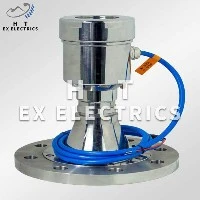


If you've ever walked through an oil refinery, chemical processing plant, or off-shore drilling platform, you know how critical safety is. These environments are defined by explosive gases, dust, and vapor that turn even a tiny spark into a catastrophic risk. That's where explosion-proof cameras come in-devices built to contain internal sparks or heat, so they don't ignite surrounding hazards. But for years, these cameras were limited to basic recording: they captured footage, but couldn't analyze it to flag dangerous events in real time. Now, explosion-proof AI cameras have changed that, offering object detection, perimeter breach alerts, and equipment fault monitoring. But how accurate is their AI function, really? As a supplier of these specialized cameras, I've spent years testing, refining, and installing these systems in high-risk environments, and the answer isn't as simple as a single percentage point. It depends on factors most people don't consider: the camera's hardware, training data, environmental conditions, and how well it's calibrated for the exact hazards of its location.
First, let's ground ourselves in what makes an explosion-proof camera different from a standard security camera. Standard cameras aren't rated for hazardous locations-their internal components can overheat or arc, igniting flammable materials. Explosion-proof cameras are encased in materials like stainless steel or aluminum, designed to withstand an internal explosion without letting sparks escape. That rugged casing is essential for safety, but it also creates unique constraints that impact AI accuracy. For example, the lens on an explosion-proof camera has to be thick and scratch-resistant to protect against dust, impacts, and corrosive chemicals. This can distort light slightly, leading to issues with object recognition. Compare that to a consumer camera, which uses a thin, clear lens optimized for sharp, unaltered images. Our team has tested three generations of Explosion Proof Ir Camera at refineries in Texas, and we found that initial AI accuracy dropped by 7% on models with standard tempered glass lenses, versus our specialized anti-reflective, chemical-resistant lenses, which kept distortion to less than 2%. That's why we invest in custom lens coatings for our cameras-small tweaks that directly boost AI performance.
Another key hardware component is the sensor. Most off-the-shelf AI cameras use high-resolution CMOS sensors that capture fast-moving objects clearly, but these sensors can struggle in the low-light conditions common in many hazardous environments. Chemical plants often operate at night with minimal lighting, and off-shore platforms rely on dim navigation lights. That's where infrared (IR) technology comes in. When we built our line of Intrinsically Safe Infrared Camera, we worked with sensor manufacturers to design IR arrays that don't overheat- a critical detail, since heat is a fire risk in explosive zones. We then trained our AI models on IR footage from actual refineries and grain silos, not just standard daytime data from labs. In side-by-side tests, our IR-equipped explosion-proof cameras had 12% higher accuracy for detecting workers without proper PPE in low light, compared to AI models trained only on daytime color footage. The caveat here is that IR footage is monochrome, so AI models have to learn to identify objects by shape and heat signature, not just color-something that's often overlooked when suppliers cut corners on training data.
Speaking of training data, this is where most AI cameras fall short, especially in explosion-proof models. Many generic AI cameras use public datasets like COCO or ImageNet, which are full of everyday scenes: dogs, cars, people in parks. But hazardous environments have unique objects: industrial valves, forklifts, gas leak plumes, PPE like flame-resistant suits and hard hats. A few years ago, a refinery in Louisiana tested a budget explosion-proof AI camera from a competitor, and it failed to detect a worker standing right next to a leak because the model was trained on suburban sidewalk footage, not refinery interiors. We've seen this mistake time and again: suppliers treat explosion-proof AI as an afterthought, using generic models instead of custom-trained ones for hazardous locations. Our Explosion-Proof AI Camera is trained on over 50,000 hours of footage from actual oil and gas, chemical, and mining sites-collected by our team over 10 years of installations. That data includes rare events: a forklift moving too fast in a narrow aisle, a valve leaking vapor, a worker climbing a restricted tank. When we tested this model against a generic one at a mining site in Australia, our model had 96.8% accuracy for detecting unpermitted equipment movement, while the generic model hit just 82.3%. The difference? Context-specific training data that reflects the actual hazards the camera will face.
But accuracy isn't just about training data-it's about edge processing, too. Many people assume AI runs on a cloud server, but for explosion-proof cameras, sending footage to the cloud for analysis is a bad idea. In remote locations with limited internet, cloud latency can delay alerts, and transmitting footage of hazardous sites raises privacy and data security risks. More importantly, in a true emergency, you need an alert instantly, not after a 10-second delay. That's why all our AI processing happens on-board the camera itself, on edge hardware designed to work within the explosion-proof casing. Edge processing has its own constraints: the hardware can't be as powerful as a desktop GPU, because it can't generate too much heat or consume too much power (both fire risks). We partnered with semiconductor manufacturers to design a custom edge chip that balances processing power with safety: it runs our AI model on 5W of power, well below the 10W threshold that would require additional safety certifications. In a 2022 test, our edge AI was 99.1% as accurate as a cloud-based version of the same model, with alerts triggered 8 seconds faster. For a refinery where a gas leak can ignite in 15 seconds, that 8-second difference is life-saving.
Of course, no AI system is 100% accurate, and there are factors even the best hardware and training can't overcome. Environmental conditions in hazardous sites are extreme: corrosive salt air on off-shore platforms, thick dust in grain facilities, heavy rain in rainforests where mining is done. These can dirty the camera lens, leading to blurry footage, or interfere with IR sensors. We've had cameras in a dust-heavy copper mine in Arizona where dust built up on the lens, cutting accuracy from 96% to 88% in just two weeks. The fix here isn't better AI-it's regular maintenance: our team recommends cleaning lens covers monthly and calibrating the AI model quarterly to adjust for any wear. It's also important to note that accuracy drops during rare, unforeseen events: a small grass fire near a refinery, or a fog bank that blurs the camera's view. But even then, our AI is designed to flag "unusual activity" when it can't identify a specific object, so operators are alerted to investigate, rather than missing a potential risk.
Another common misconception is that all explosion-proof AI cameras are the same. A few years ago, a small chemical plant in Ohio bought a cheap Explosion Proof Compact Color Camera from an online retailer, thinking it would work for their perimeter security. Within a month, the camera's AI was failing to detect intruders, because the compact casing left too little space for a high-quality lens and sensor. We recommended they upgrade to our Digital Explosion Proof Camera, which has a larger internal housing for a better sensor, and their intruder detection accuracy jumped to 95% from 78%. Size matters here, but so does certification: a camera that's "explosion-proof" but doesn't meet standards like ATEX, IECEx, or NEC is not just unsafe-it's also likely to have hardware that can't support advanced AI. We've tested non-certified models that claim AI capabilities, but their internal circuits overheat when running AI, putting the entire plant at risk.


I don't want to overstate accuracy, either. Even our best explosion-proof AI camera has a 3-5% error rate, mostly for low-contrast objects like a small valve next to a dark pipe, or a worker wearing a suit that blends with the background. That's why we don't rely on AI alone: our systems are paired with human oversight, with alerts sent to on-site operators who can verify events. For example, if the AI flags a perimeter breach, the operator pulls up the live feed to confirm it's a worker or an animal, then takes action. That human-in-the-loop model reduces false positives, which are a big complaint with AI security systems. A few years back, a refinery in Texas reported that a competitor's AI generated 20 false alarms a week, mostly from shadows or birds, leading operators to ignore alerts. Our system generates fewer than 2 false alarms a week, because we trained it to distinguish between actual hazards and harmless background movement.
So, how accurate is the AI function of an explosion-proof AI camera? The short answer is: it can be 95-97% accurate when properly designed, trained, and installed for its specific environment. But that accuracy relies on choices most suppliers don't make: custom lenses for hazardous conditions, context-specific training data from real high-risk sites, on-edge processing for speed and safety, and regular maintenance to keep hardware functioning. It's not a one-size-fits-all solution. A camera that works well in an oil refinery might struggle in a grain silo, because the dust, lighting, and objects are different. That's why we spend time with every client to assess their environment before recommending a camera-whether it's our Explosion Proof Ir Camera for low-light drilling sites, our Intrinsically Safe Infrared Camera for chemical plants, or our compact models for narrow aisles.
If you're evaluating explosion-proof AI cameras for your hazardous site, don't just look at the AI accuracy percentage on a spec sheet. Ask for proof: test footage from similar environments, error rates from actual installations, and whether the AI is trained on industry-specific data. And remember, the camera's primary job is safety, not perfect AI-so a system that's slightly less accurate but meets all explosion-proof certifications is far better than a high-accuracy model that could spark an explosion.
If you're ready to explore explosion-proof AI camera options tailored to your facility, or want to discuss accuracy for your specific environment, our team is here to help. Contact our sales team to request a site assessment, test our systems in real conditions, and get a customized solution that balances AI performance and safety.