



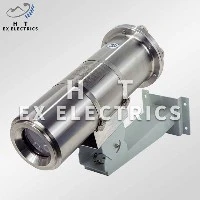
If you've ever worked in industries like oil and gas, chemical manufacturing, mining, or grain processing-environments where flammable gases, dust, or vapors are present-you know how critical it is to have reliable, visible monitoring without risking a spark. That's where explosion-proof IR cameras come in, and one of the most common questions I get as a supplier of these specialized devices is: "What's the signal-to-noise ratio (SNR) of an explosion-proof IR camera?" It's not a simple one-number answer, because SNR depends on a mix of engineering choices, operational conditions, and the unique constraints that come with designing a camera for hazardous locations. Let's break this down, in plain terms, so you can make an informed choice for your site.
First, let's start with the basics for anyone who might not be a camera engineer. SNR is a measure of how much desired image signal (the heat or infrared light we want to capture) exists compared to unwanted noise (graininess, static, or random distortions that make an image blurry or unreadable). A higher SNR means a clearer, more usable image; a lower SNR means you're missing critical details-like a hot spot on a processing vessel that could turn into a fire, or a leak in a pipeline-that you need to catch early. For standard consumer or commercial IR cameras, you might see SNR specs from 40dB to 60dB, but explosion-proof cameras have to balance that performance with strict safety rules.
Explosion-proof design isn't just adding a metal box around a regular camera. The National Electrical Code (NEC) and International Electrotechnical Commission (IEC) have tight standards for devices in Class I, Division 1 or Zone 1 areas-places where flammable material is present 24/7, or under normal operation. Any spark, overheated component, or excess electricity from a camera has to be contained so it can't ignite surrounding material. That means extra heavy-duty enclosures, sealed wiring, and often limited power inputs compared to regular cameras. All of these safety features can impact SNR, because less power might mean less light captured, or a thicker lens window might reduce IR transmission.
As someone who's worked with these cameras for years, I can tell you that most quality explosion-proof IR cameras have an SNR ranging from 35dB to 55dB. Wait-why the wide range? Because it's not just a spec; it's tied to how the camera is built and how you're going to use it. Let's talk about the factors that shift that number. First, the type of infrared sensor. Thermal IR sensors (used for heat detection) vs. near-IR sensors (used for low-light visual monitoring) have different SNR capabilities. Thermal sensors, which are common in industrial maintenance, usually have lower inherent noise when paired with good signal processing, while near-IR might have higher noise but work better for color imaging in dim hazardous areas.
Another big factor is the enclosure. Explosion-proof enclosures aren't just metal; they have pressure seals to contain any internal spark, and often a sapphire or IR-transmissive glass window. Cheaper enclosures use thinner glass that blocks more IR light, which reduces the signal your sensor gets, lowering SNR. Higher-quality enclosures use optical-grade sapphire that transmits 90%+ of the target IR wavelength, so you keep more signal without adding noise. For example, our line of explosion-proof IR cameras, built for Class I Div 2 and Zone 2 locations, use that sapphire window to maintain a 48dB SNR even in dusty or high-humidity environments that would drag other cameras down.


Don't forget about power constraints. Intrinsically safe designs, which are a subset of explosion-proof devices that limit power to prevent sparks, can have a harder time with SNR than non-intrinsically safe models. Intrinsically safe cameras have to meet strict limits on voltage and current, so the sensor and processing circuit can only draw a small amount of power. That means they might have a bit more noise-usually around 35dB to 42dB-but that's a tradeoff for being safe in the most hazardous zones. If you're in a Zone 1 area where even a tiny spark is a risk, you'll need an intrinsically safe camera, and that lower SNR is worth it for the safety compliance. If you're in a less risky Zone 2 or Class I Div 2 area, you can opt for a non-intrinsically safe explosion-proof camera with a higher SNR, around 50dB to 55dB, because it doesn't have the same power limits. I'd point you to our intrinsically safe infrared camera page if you need that lowest-power, highest-safety option, or our explosion-proof IR camera page for a range of models tailored to different zone requirements.
Environmental conditions also play a huge role in real-world SNR, not just the factory spec. If you're using the camera in a dusty refinery, a snowy outdoor mine, or a high-temperature chemical plant, dust on the lens window can block IR light, cutting signal by 10-20% and lowering SNR. Cold temperatures can make sensor noise worse, while extreme heat can warp the lens or cause processing circuits to add more noise. That's why top explosion-proof IR cameras include built-in lens heaters and self-cleaning functions-small features that keep SNR consistent when conditions get tough. I once had a client in a Canadian mining site tell me their old standard IR camera dropped from 52dB to 38dB in winter, but our explosion-proof PTZ camera with a heated lens stayed at 47dB, so they could still monitor conveyor belt hot spots even at -20°F. That's the kind of real-world performance SNR that matters more than a factory number.
Wait, let's also clear up a common misconception: SNR isn't the only spec that makes an explosion-proof IR camera good. A camera might have a high SNR, but if its resolution is low, you won't be able to see the hot spot anyway. Or if it's not properly certified for your specific hazardous zone, the high SNR is irrelevant because the camera isn't allowed in the area. That's why our team always works with clients to balance SNR needs with safety compliance. For example, if a chemical plant needs to monitor small pipeline leaks 50 feet away, a 50dB SNR camera will give a clear enough image to spot a 10°C temperature difference, which is critical for early leak detection. If a grain elevator just needs to monitor large storage silos for fire hot spots, a 40dB SNR camera will be enough, and an intrinsically safe model will meet their Zone 20 dust hazard rules.
Another thing to consider: digital signal processing (DSP). Many explosion-proof IR cameras use DSP to boost signal and reduce noise without amplifying both signal and noise equally. Good DSP can add 5-10dB to the effective SNR, making a 40dB camera perform like a 45dB one. But cheap DSP can introduce artifacts-blurry edges or false hot spots-so you need a camera with proven DSP for industrial environments. Our explosion-proof AI camera models use advanced DSP to optimize SNR specifically for hazardous areas, so you get clear images without extra processing that could add heat (and a spark risk) to the camera.
Now, let's talk about how to measure SNR for explosion-proof cameras, because not all measurement methods are the same. Some manufacturers measure SNR in a controlled lab with a perfect light source, while others measure it in real-world conditions with dust and temperature fluctuations. Always check how the SNR is tested. Lab-tested SNR numbers are usually higher, but real-world SNR is what you care about. As a supplier, I always provide both: the lab spec under standard test conditions, and the typical real-world SNR our clients see in their facilities. That way, you're not getting a misleading number that doesn't match what you'll actually use.
So, to wrap up: the SNR of an explosion-proof IR camera isn't a single number. It ranges from 35dB for low-power intrinsically safe models in the most hazardous zones, up to 55dB for higher-power explosion-proof models in less risky areas, with DSP and proper enclosure design keeping that number consistent even in tough conditions. The key is to match your camera's SNR to your site's needs and safety requirements. If you're not sure which type is right for you, whether you need an intrinsically safe device or a PTZ camera for wide-area monitoring, our team is here to walk you through the specs and real-world performance of all our models. We don't just sell cameras-we work with industrial operators to make sure they have the monitoring tools that keep their facilities safe. If you'd like to discuss your specific application, reach out to our team to start a purchasing conversation.